Case erecting automation is often the first major step companies take when upgrading their end-of-line packaging operations. By replacing manual box forming with automated case erecting machines, facilities aim to improve production speed, reduce labor dependency, and achieve greater packaging consistency.
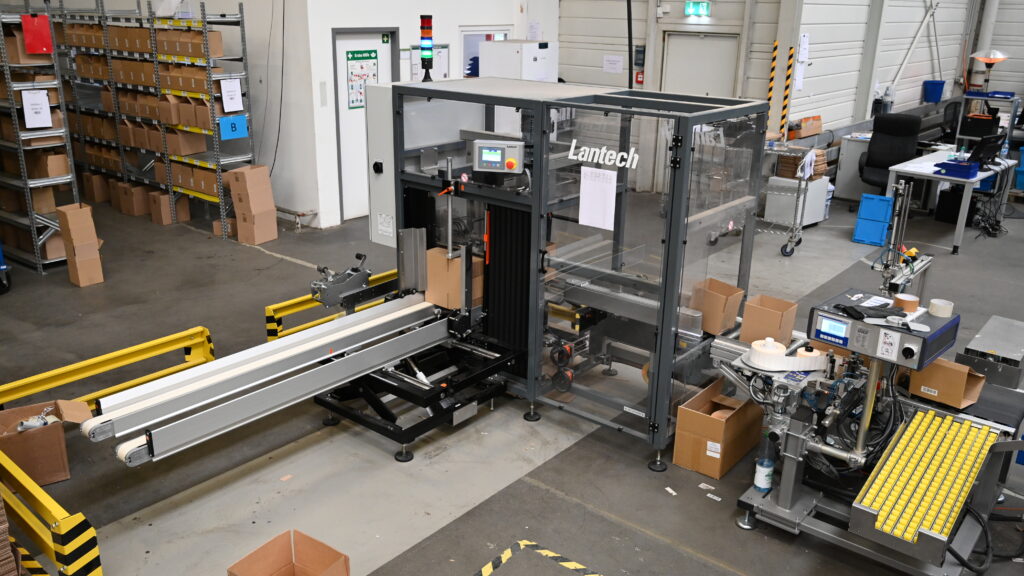
Lantech has established itself as a recognized provider of packaging automation equipment, particularly in stretch wrapping and case, tray and lid handling systems. This Lantech case erector review provides a fact-based examination of how Lantech case erecting machines operate, what differentiates their technology, how they perform in real production environments, and where they are most commonly applied.
This review is based on actual technical input from product experts and practical observations from installations across manufacturing, distribution, and fulfillment operations.
Table of Contents
- Overview of Lantech Case Erector Technology
- Key Features and Innovations
- Performance and Efficiency Advantages
- Applications Across Industries
- How Lantech Case Erectors Improve Safety and Ergonomics
- Choosing the Right Lantech Case Erector Model
- Cost, Maintenance, and ROI Considerations
- Conclusion
- FAQs
Overview of Lantech Case Erector Technology
Lantech case erectors are designed to pick, form, square, and discharge corrugated cases with controlled, repeatable motion. The core principle behind their technology is not extreme speed, but precise movement and reliable box control throughout the erecting cycle.
How the erecting process works
At a functional level, the case erecting process follows a controlled sequence:
- Horizontal magazine loading – Case blanks are staged in a straight-walk-in horizontal magazine rather than a gravity-fed or overhead system.
- Box indexing to the forming area – Blanks are advanced into a controlled “on-deck” position.
- Vacuum pickup and case opening – Eight suction cups grip the major and minor panels and open the case squarely to form 90 degree angles.
- Flap control and squaring – Bottom minor and major flaps are closed to lock in the case geometry before movement.
- Discharge through controlled belts – Spring-loaded rubber discharge belts guide the squared box downstream while compensating for small width variations.
- Transfer to sealing or downstream conveyors – The erected case exits into either a manual or automated conveyor system.
The machine relies on small, accurate, repeatable movements, rather than complex multi-axis motion. This design philosophy prioritizes repeatability and long-term reliability, even when corrugated blank quality varies.
Technology emphasis
While Lantech machines incorporate modern PLC controls, sensors, and safety interlocks, the technical emphasis remains on mechanical accuracy and controlled forces, rather than high-speed complexity. This contributes to stable operation across a wide range of real-world corrugate conditions.
Key Features and Innovations
The following features define the Lantech case erecting platform:
1. Horizontal magazine design
Unlike gravity-fed or overhead magazine systems, Lantech uses a horizontal, walk-in magazine. This improves:
- Operator ergonomics when loading blanks
- Visibility of blanks inside the machine
- Consistency of blank feeding
- Reduced risk of skewed or jammed cases
2. Precision suction and squaring
The suction-based pickup system allows the machine to:
- Grip both major and minor panels
- Open cases squarely before movement
- Compensate for inconsistent glue joints in the corrugated blank to a degree
This design helps force imperfect cases into true square cases with 90-degree corners before downstream transfer.
3. Controlled discharge belts
Spring-loaded discharge belts made from specialized rubber allow the machine to adapt to small case width discrepancies while maintaining sidewall pressure. This prevents:
- Case pop-up at the tape head
- Sidewall distortion under sealing pressure
- Downstream skew
4. Watchdog timer control logic
Integrated watchdog timers prevent the machine from continuing operation during fault conditions, improving machine protection and operator safety.
5. Flexible sealing platforms
Sealing options include:
- 2-inch tape (standard)
- 3-inch tape (optional)
- Hot melt glue (optional)
- Standard: Robatech
- Optional: Nordson
6. Tool-less changeover
Case size changeovers rely on analog dials and preset adjustment points, with no measuring tools required. Box-specific setup “cheat sheets” are created during commissioning for repeatability.
Performance and Efficiency Advantages
Lantech positions performance around consistent uptime, reliable case control, and stable throughput, rather than maximum speed.
Speed and throughput
- Lantech case erectors operate up to approximately 30 cases per minute
- The company intentionally avoids ultra-high-speed (60+ CPM) designs
- The focus is placed on durability, reliability, and controlled operation
Reliability focus
Reliability is built on three primary principles:
- Physical case testing before system configuration
- Accurate low-complexity movement design
- Proven industrial control components (e.g., Allen-Bradley PLCs, industrial enclosures, vetted pneumatic and electrical suppliers)
This design approach supports:
- Stable operation with variable corrugated blanks
- Reduced jam rates
- Predictable long-term performance
- Fewer catastrophic mechanical failures
Case quality and packaging consistency
By maintaining square geometry before discharge and controlling case pressure during sealing, Lantech machines deliver:
- Improved case integrity
- Consistent box shape for downstream automation
- Reduced seal failures
- Better pallet stability after packing
Applications Across Industries
Lantech case erectors are deployed across a wide range of industries, particularly where distribution and shipment volumes are high.
Common applications include:
- E-commerce fulfillment centers – High SKU variety, moderate speeds, constant changeovers
- Logistics and distribution facilities – Repack and redistribution operations
- Food and beverage – Secondary packaging for shipment
- Pharmaceuticals – Controlled environments with emphasis on consistency
- General manufacturing – Finished goods packaging
The machines are particularly well suited for RSC and HSC case styles. While Lantech can support certain specialized cases within these categories, their strength is squarely within standard shipping case applications rather than exotic or ultra-high-speed formats.
How Lantech Case Erectors Improve Safety and Ergonomics
Safety and ergonomics are engineered directly into multiple areas of the machine design.
1. Operator loading ergonomics
- Horizontal magazine height reduces awkward lifting
- No overhead loading that places strain on shoulders
- Improved blank visibility for faster reloads
2. Full guarding and visibility
- Clear plexiglass guarding (“fishbowl” design)
- Side curtains and top guarding at infeed
- No open access to moving components
- Door interlocks shut down air and electric when opened
3. Tool-less changeovers
- No hand tools required for size changes
- No guess measurements
- Dial-based repeatable settings
- Reduced pinch-point exposure during setup
4. Reduced repetitive manual motion
By removing manual folding and squaring tasks, operators experience:
- Lower repetitive strain exposure
- Reduced wrist, shoulder, and lower-back stress
- Less fatigue over long shifts
Choosing the Right Lantech Case Erector Model
Selecting the correct model depends on production volume, staffing resources, and automation maturity.
Selecting the appropriate Lantech case erector depends largely on your facility’s volume, case-size requirements, available floor space, and how automated the rest of your line is. Below is a breakdown of the main Lantech model families and guidance on which fits different use cases.
| Model Family | Typical Use Case / Volume | Case Size Range (outside dims) | Approximate Throughput | Comments / Considerations | Footprint |
| C300 / C400 | Low- to mid-volume operations; small to medium cases; replacing manual erecting or semi-automatic folding | Min: 200 mm L x 150 mm W x 150 mm H (7 7/8″ L x 5 7/8″ W x 5 7/8″ H)
C300 Max: 500 mm L x 350 mm W x 600 mm H (19 5/8″ L x 13 3/4″ W x 23 5/8″ H) C400 Max: 620 mm L x 450 mm W x 650 mm H (24 3/8″ L x 17 3/4″ W x 25 5/8″ H) |
Up to 8-10 cases/minute | Best for operations with modest output. Simple loading-magazine, good for facilities with limited floor space or automation budget. Lower throughput means easier maintenance and less demand on upstream/downstream equipment. | C300: 2140 mm L x 2235 mm W x 1600 mm H (84 1/4″ L x 88″ W x 63″ H)
C400: 2310 mm L x 2375 mm W x 1600 mm H (91″ L x 93 1/4″ W x 63″ H) |
| C1000 / C2000 | Mid- to higher-volume packaging lines needing consistent production, moderate case size flexibility | Min: 200 mm L x 150 mm W x 150 mm H (7 7/8″ L x 5 7/8″ W x 5 7/8″ H)
C1000 Max: 500 mm L x 325 mm W x 520 mm H (19 5/8″ L x 12 3/4″ W x 20 1/2″ H) C2000 Max: 620 mm L x 450 mm W x 650 mm H (24 1/2″ L x 17 3/4″ W x 25 5/8″ H) |
Configurable up to 30 cases/minute | Offers flexibility, higher throughput and modular options (tape or hot melt, magazine extensions, stainless frame, etc.). A good balance of speed and cost for many packaging operations. | C1000: 2225 mm L x 2280 mm W x 1800 mm H (88 3/4″ L x 89 3/4″ W x 70 7/8″ H)
C2000: 2540 mm L x 2480 mm W x 1800 mm H (100″ L x 97 5/8″ W x 70 7/8″ H) |
| CI1000 / CI2000 | Inline operations where multiple machines are closely integrated; moderate to high throughput; compact width footprint requirement | Min: 200 mm L × 150 mm W × 150 mm H (7 7/8″ L x 5 7/8″ W x 5 7/8″ H)
CI1000 Max: 500 mm L x 325 mm W x 520 mm H (19 5/8″ L x 12 3/4″ W x 20 1/2″ H) CI2000 Max: 620 mm L x 450 mm W x 650 mm H (24 1/2″ L x 17 3/4″ W x 25 5/8″ H) |
Configurable up to 25 cases/minute | Designed for integration into long, inline packaging lines. Narrow machine width helps when lines are densely arranged; good for multi-SKU, mixed-case operations requiring flexibility. | CI1000: 3400 mm L x 1325 mm W x 2400 mm H (133 7/8″ L x 52 1/6″ W x 94 1/2″ H)
CI2000: 3580 mm L x 1570 mm W x 2400 mm H (141″ L x 61 4/5″ W x 94 1/2″ H) |
| MFC1000 / MFC2000 | Larger facilities or high-volume operations where maximum flexibility, robustness, and long-term heavy-duty performance are required | Min: 200 mm L x 150 mm W x 150 mm H (7 7/8″ L x 5 7/8″ W x 5 7/8″ H)
MFC1000 Max: 500 mm L x 325 mm W x 520 mm H (19 5/8″ L x 12 3/4″ W x 20 1/2″ H) MFC2000 Max: 620 mm L x 450 mm W x 650 mm H (24 1/2″ L x 17 3/4″ W x 25 5/8″ H) Non-Standard Case Dimension Option: Machine can be modified for a variety of case dimensions. Please contact Lantech for details. |
8-18 cases/minute (model, options and application can change speed) | Best suited for industrial operations with high case volume, frequent changeovers, and integration into a broader automation ecosystem — especially where future growth is expected or multiple packaging lines feed a central palletizing/shipping area | MFC1000: 4345 mm L x 2030 mm W x 1980 mm H (171″ L x 80″ W x 78″ H)
MFC2000: 5070 mm L x 2030 mm W x 1980 mm H (200″ L x 80″ W x 78″ H) |
Key selection factors include:
- Daily case volume
- Available maintenance support
- Complexity of the packaging line
- Number of box size SKUs
- Floor space availability
- Preferred sealing method
Facilities with only one maintenance technician often align best with simpler platforms such as the C300 and C400, while high-volume operations with dedicated maintenance teams are better suited to Multi-Format Case Erector systems.
How to Choose Among Models
- Start with your process. If your operation doesn’t require high flexibility or many customized options, a C300/C400 often delivers the result you need at a lower cost with a machine that is easy to use and user friendly.
If you anticipate growth, higher volume or a more customized option (e.g., continuous shifts, larger case sizes, multiple SKUs), consider the C1000/C2000. This family offers a strong balance of speed, flexibility, and support for larger case formats.
For tightly integrated packaging lines or limited floor width, the inline CI1000/CI2000 models are ideal — especially when you need to maximize throughput without expanding floor width.
For case production that requires random case sizes, MFC-series machines warrant consideration. Their scalability and robustness make them well-suited to large manufacturing, distribution, or 3PL facilities.
Cost, Maintenance, and ROI Considerations
Maintenance expectations
Routine maintenance needs are intentionally limited:
- Daily visual inspections
- Keeping vacuum filters clean
- Checking pneumatic air dryness
- General fastener inspection
- Cleaning corrugated dust from suction components
No routine lubrication is required. Maintenance intensity varies by environment (dusty, sugary, wet, or sanitary operations demand more frequent cleaning).
Read more about common maintenance requirements of case erectors in this article.
Spare parts strategy
- Only minimal spare parts are typically required
- Common items include suction cups and tape blades
- Most components are standard industrial parts
- Replacement parts are readily available through distribution and factory support
Spare parts shelf inventories are intentionally kept small because unused parts may expire before use.
Warranty coverage
- 3-year unlimited-cycle warranty on case equipment
- Covers most machine components
- Wear items excluded (belts, tape blades, suction cups)
- Service labor billed separately
ROI expectations
ROI depends on:
- Labor wages and benefits
- Daily box volume
- Damage and rework rates
- Upstream and downstream line efficiency
Operations producing over 500 boxes per day typically achieve payback in two to three years, with many seeing faster returns depending on labor savings and throughput improvements.
Automation often delivers ROI not only through labor reduction, but also via:
- Damage reduction
- Improved throughput consistency
- Lower employee turnover
- Better ergonomic safety outcomes
Lantech’s labor savings calculator helps companies understand how much labor is already costing them with their manual case erecting process.
Conclusion
This Lantech case erector review demonstrates a platform engineered for consistency, controlled performance, and long-term reliability rather than extreme speed. With precise case control, robust safety systems, and simplified maintenance requirements, Lantech case erectors are well suited for distribution, fulfillment, and mid-volume manufacturing environments seeking dependable packaging automation.
By focusing strategically on RSC/HSC case formats, repeatable mechanical accuracy, and proven industrial components, Lantech positions its case erectors as stable, serviceable solutions for facilities upgrading from manual to automated end-of-line operations.
FAQ
1. What makes Lantech case erectors different from other brands?
Lantech emphasizes precise, low-complexity motion control rather than ultra-high speeds. The machines rely on accurate short movements, horizontal magazines, spring-loaded discharge belts, and proven industrial components to create square cases and maintain reliability across varied corrugated blank quality.
2. Which industries benefit most from case erector automation?
Lantech case erectors are commonly used in e-commerce fulfillment, logistics and distribution, food and beverage, pharmaceuticals, and general manufacturing, particularly in operations shipping RSC and HSC style cases.
3. How do Lantech case erectors improve packaging consistency?
Consistency is achieved through precise suction pickup, controlled squaring before discharge, and stabilizing discharge belts, ensuring boxes maintain proper geometry through sealing and downstream automation.
4. What factors determine the right case erector model?
Key factors include daily production volume, maintenance staffing, number of box size SKUs, floor space, sealing method, and overall line automation level.
5. What sealing options do Lantech case erectors support?
Supported options include:
- 2-inch tape (standard)
- 3-inch tape (optional)
- Hot melt glue (Robatech standard, Nordson optional)
6. How much maintenance do Lantech case erectors require?
Maintenance is generally limited to cleaning vacuum filters, inspecting pneumatics, checking fasteners, and keeping the machine free of dust and debris. No routine lubrication is required.
7. What ROI can companies expect from adopting a case erector?
Operations producing over 500 boxes per day typically achieve payback in two to three years, with many seeing faster returns depending on labor savings and throughput improvements.