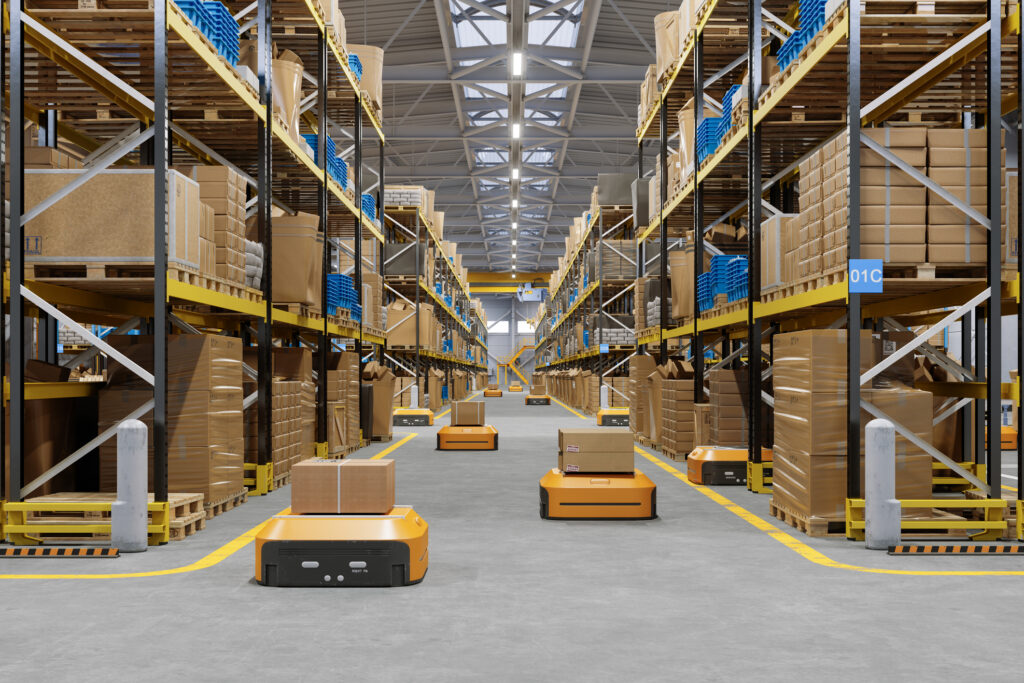
For most of warehouse automation’s history, the conveyor was the backbone. It determined the floor layout, dictated the sequencing of operations, and defined where end-of-line packaging had to live. Everything else worked around it. When autonomous mobile robots entered the picture, they did not simply replace the conveyor — they changed the logic of the entire system.
That shift has direct consequences for how solution design engineers should think about end-of-line packaging in warehouse automation projects. The opportunities are real — decentralized operations, eliminated floor barriers, and scalability that does not require tearing out infrastructure. But capturing those opportunities requires specifying packaging equipment that was built for how AMR-driven facilities actually work, not retrofitted to survive in them. This post walks through what changes, what it means for your design, and what to look for when specifying the wrapping station.
Contents
- The Conveyor Constraint — and What Removing It Actually Means
- Three Key Shifts in End-of-Line Design
- Performance and Efficiency Benefits That Follow
- What Packaging Equipment Has to Do Differently
- AMR End-of-Line Design Checklist
The Conveyor Constraint — and What Removing It Actually Means
Conventional automated warehouse design organizes operations sequentially. Product moves from receiving to storage, to pick to pack, then to wrap along a physical path — and that path is fixed. Conveyors are fast and reliable within that model, but they impose costs that are rarely fully accounted for in the design phase: floor space consumed by the infrastructure itself, physical barriers that partition the facility into zones that cannot flex, and a scalability ceiling tied to the capital cost of physical extension.
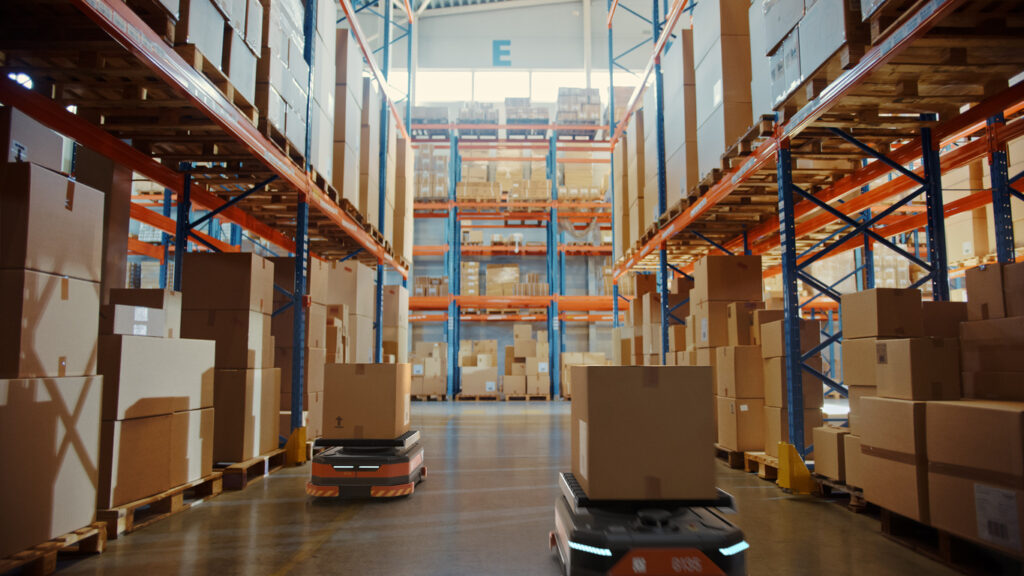
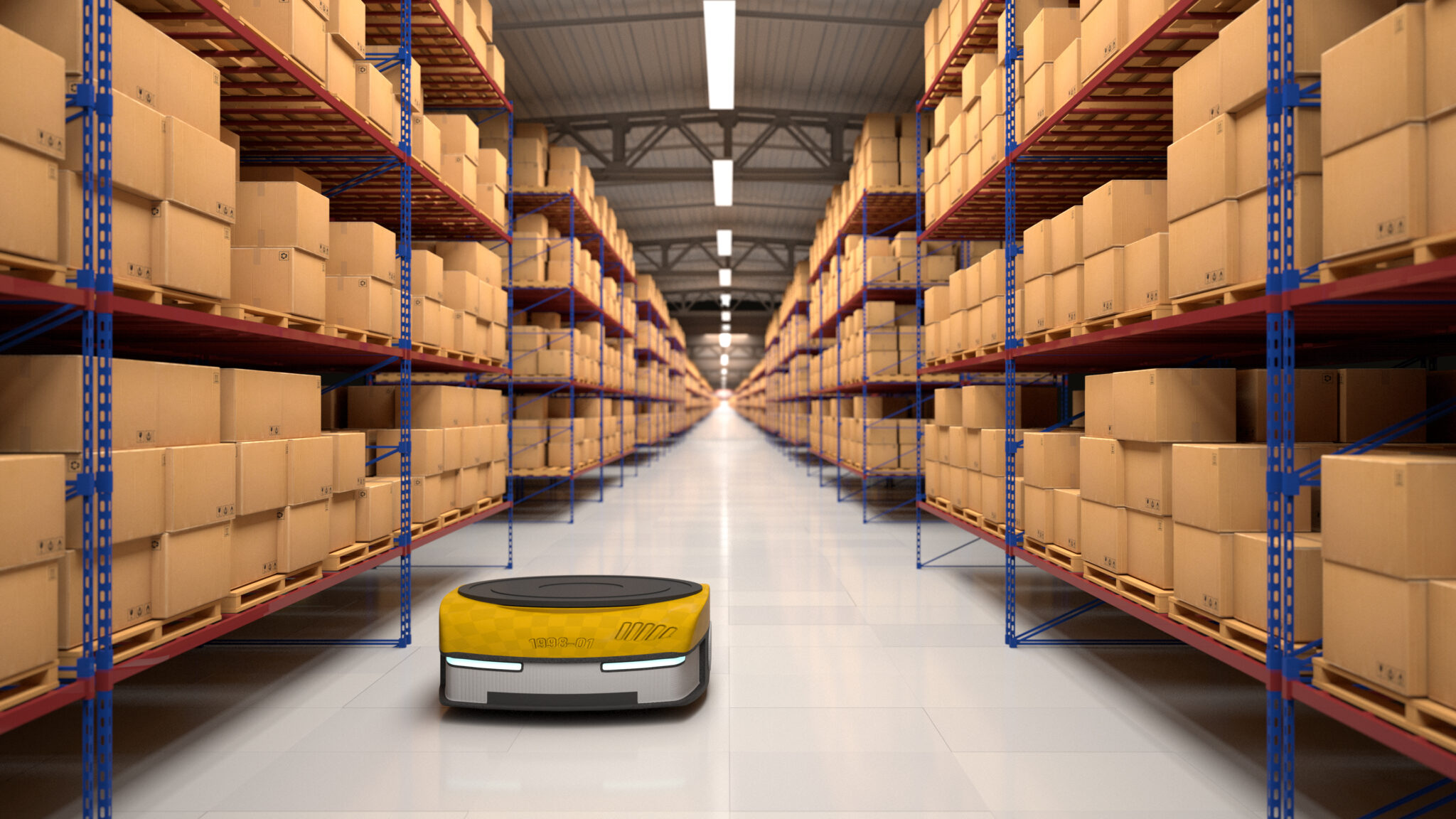
AMRs do not move product along a fixed path. They navigate. They go where they are needed, when they are needed, using LIDAR and sensor arrays to operate safely across open floor space. When AMRs take over the transport function, the facility’s operational logic changes from a fixed sequence to a flexible network. That is not a small difference. It is a foundational shift in what warehouse automation can look like — and it starts at the design phase.
Three Key Shifts in End-of-Line Design
Decentralized Operations
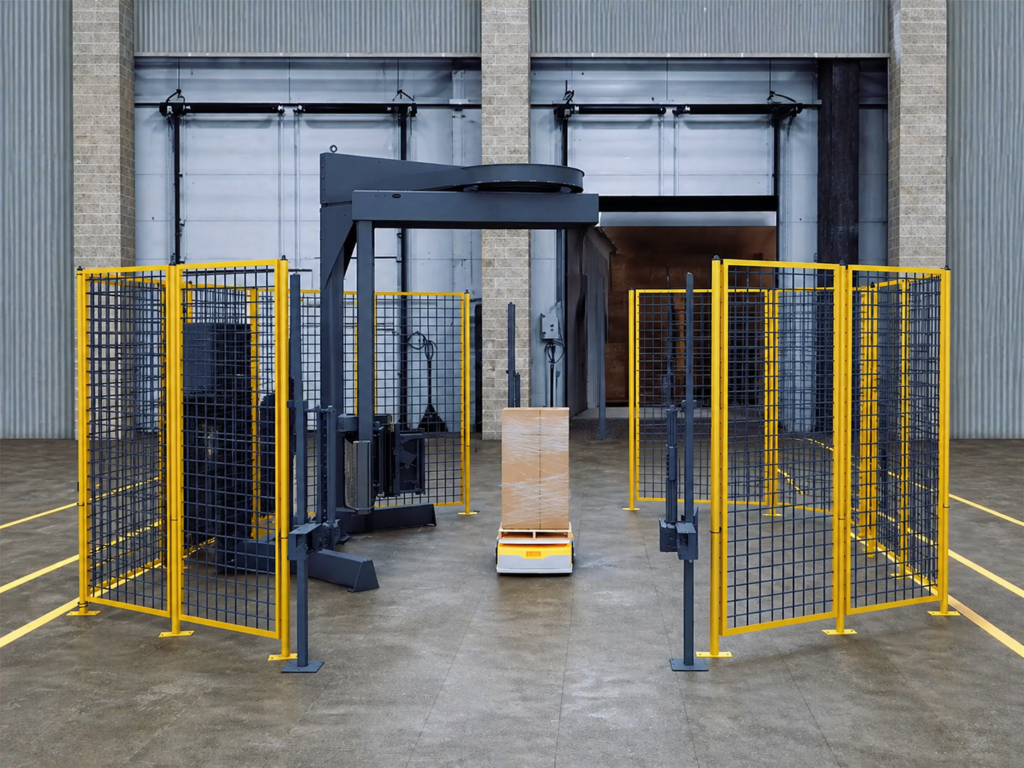
In a conveyor-dependent facility, packaging happens where the line ends. The wrap station is where the conveyor terminates — which is often a compromise location dictated by structural constraints, loading dock positions, or legacy layout decisions. AMRs break that dependency. Because the robot travels to the load rather than the load traveling to a fixed point, wrapping stations can be positioned where they make operational sense for the workflow, not where the floor infrastructure allows.
For solution design engineers, this opens layout options that are simply unavailable in conventional designs. Multiple distributed wrap stations, each served by AMRs, can eliminate bottlenecks that previously formed at a single end-of-line point. The constraint on packaging throughput shifts from physical infrastructure to AMR fleet size — a much more flexible variable.
Elimination of Floor Barriers
Conveyor systems create physical partitions in a facility. The infrastructure occupies floor space, requires maintenance aisles, and divides the warehouse into zones that are difficult to repurpose. AMRs navigate open floor using onboard sensors — they do not require dedicated lanes or fixed pathways. That means the floor plan stays flexible and the space that would have been consumed by conveyor runs remains available for storage, staging, or future reconfiguration.
The practical implication for design engineers: packaging equipment footprint matters more in an AMR environment than in a conventional one. A smaller machine footprint means more navigable floor space, fewer sensor interference zones, and a cleaner path for autonomous vehicles operating at scale. Specifying a wrapper with a compact, low-profile design is not an aesthetic preference — it is a system performance decision.
Ease of Scalability
Scaling a conveyor-based system typically means physical modification: extending lines, adding transfer equipment, or reconfiguring zones. It is capital-intensive, disruptive, and often requires facility downtime to implement. Scaling an AMR-based system means adding robots. The infrastructure supports incremental growth without structural change.
End-of-line packaging has to scale the same way. Equipment that requires conveyor integration, ramps, or fixed infeed infrastructure creates a scalability constraint in a system designed to avoid exactly that. Wrapping equipment that operates independently — no conveyors required, loads placed directly on the floor — stays compatible with the scalability model the rest of the system is built on.
Performance and Efficiency Benefits That Follow
The design shifts above are structural. The efficiency gains are operational — and they compound over time.
Continuous operation. AMRs do not take breaks, do not require shift handoffs, and are not subject to the throughput variations that come with manual labor. When the transport function runs continuously, the wrapping station becomes the cycle-rate constraint. Equipment that wraps without operator intervention — automatic film cutting, automatic film tail management, self-configuring wrap profiles — keeps pace with the continuous flow that AMR fleets deliver.
Just-in-time delivery to workstations. AMRs enable on-demand product movement rather than batch-based conveyor flow. Wrapping stations receive loads when they are ready, not on a fixed cadence. This reduces queue accumulation, minimizes work-in-process inventory on the floor, and creates a tighter link between upstream operations and outbound readiness.
Reduced manual labor at packaging. The labor savings from AMR adoption extend to end-of-line only if the packaging equipment does not reintroduce manual touchpoints. Film cuts, load placement, wrap cycle restarts after film breaks — each one is a point where a person has to intervene and the autonomous loop breaks. Equipment designed for minimal operator interaction preserves the labor model that AMR adoption creates.
Seamless integration with packaging equipment. AMRs communicate with warehouse execution systems (WES) via standard protocols. The most capable wrapping equipment now includes digital interfaces that allow wrap cycle data — cycle counts, film usage, containment force records, fault flags — to feed directly into those systems. That data closes the visibility loop between packaging performance and overall operational reporting.
What Packaging Equipment Has to Do Differently
The AMR-driven warehouse creates a clear specification profile for end-of-line wrapping equipment. It is not a long list, but every item on it is non-negotiable in a system designed for autonomous operation.
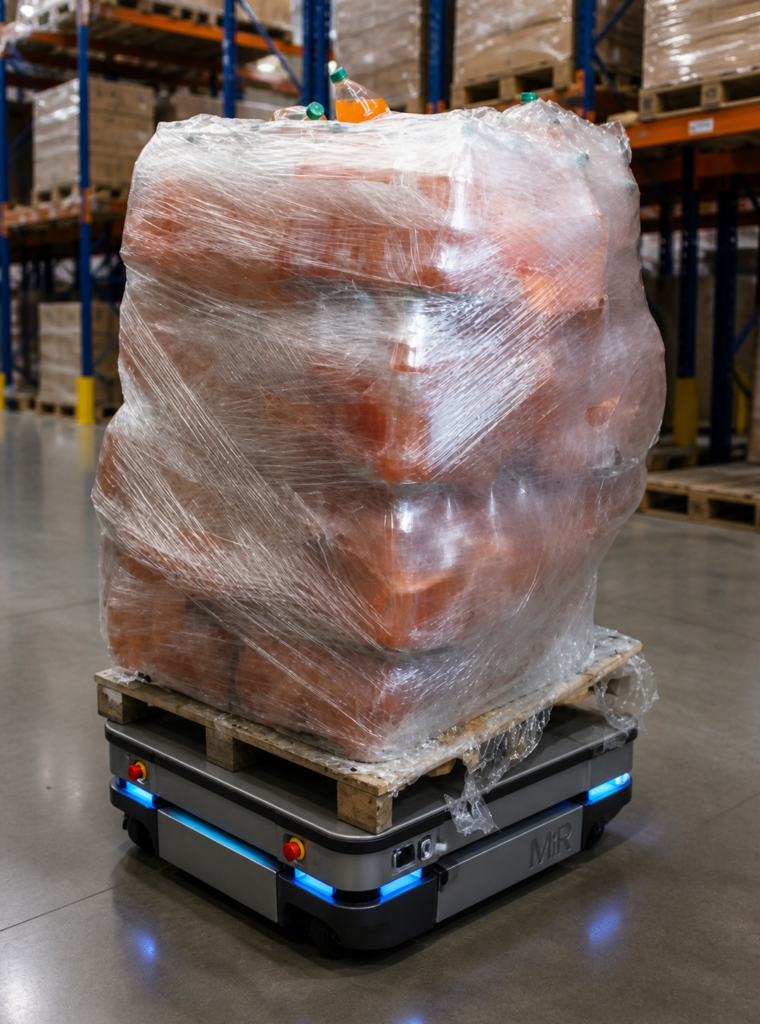
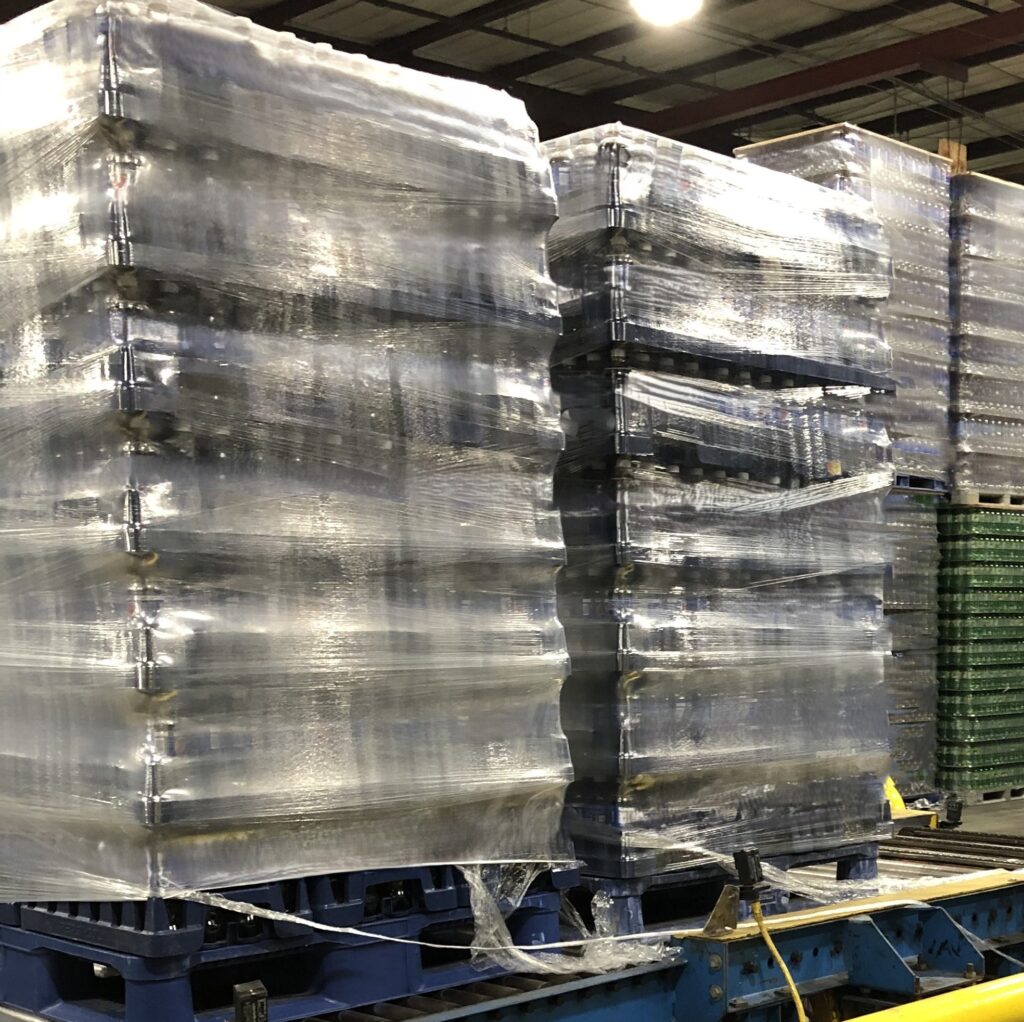
Film tail elimination is the most operationally critical requirement. A trailing film tail in an AMR environment does not create a wrapping problem. It creates a system-level event. The AMR’s LIDAR reads the tail as an obstruction. The robot stops. If no operator is nearby — and in a highly automated facility, they often are not — the backlog accumulates until someone walks over and clears it. A single film tail can halt a $100M system. Specifying equipment that eliminates film tails at every cycle is not a feature preference; it is a risk management decision.
Beyond film tail management, equipment must operate without conveyors or ramps — so AMRs can deliver loads directly and retrieve them without fixed transfer infrastructure. Wrap cycle configuration must adapt automatically to load variability, since operator-dependent settings are incompatible with high-throughput autonomous workflows. And the machine’s physical footprint must leave adequate navigable floor space for the AMR fleet to operate efficiently around it.
Lantech’s SL400AMR was designed against exactly this specification profile. No conveyors, no ramps, floor-level load placement, TurboTak® film tail elimination, Load Guardian® automatic wrap profile selection, and a digital interface compatible with AMR-integrated WES architectures. It is not a conventional wrapper adapted for AMR environments. It is equipment built for them.
AMR End-of-Line Design Checklist
Apply this to your next warehouse automation project when specifying end-of-line wrapping equipment.
Layout and Infrastructure
- ☐ Wrap station placement is determined by workflow logic, not conveyor terminus location
- ☐ Equipment operates without conveyors, ramps, or fixed infeed infrastructure
- ☐ Machine footprint preserves adequate AMR navigation clearance on all approach vectors
- ☐ Multiple wrap stations evaluated if single-point throughput creates a bottleneck at peak volume
AMR Compatibility
- ☐ Equipment eliminates film tails at every cycle — no trailing film that can falsely trigger AMR sensors
- ☐ AMR compatibility confirmed for fleet in use (KUKA, MiR, Geek+, Quicktron, etc.)
- ☐ AMR docking and load handoff positions accounted for in floor layout design
- ☐ Sensor interference zones mapped — equipment profile reviewed against AMR LIDAR field
Operational Autonomy
- ☐ Wrap cycle is fully automated — no manual film cuts, no operator-dependent profile selection
- ☐ Equipment auto-adjusts to load variability without operator input between cycles
- ☐ Film break frequency and MTTR reviewed — film breaks are the leading cause of stretch wrapper downtime
- ☐ No weight restrictions on equipment — compatible with full load variability in the project
Integration and Data
- ☐ Digital interface specifications confirmed — signal I/O, protocol, and WES data feed requirements documented
- ☐ Wrap cycle data (cycle count, film usage, fault codes) feeds into WES or client reporting system
- ☐ Integration documentation delivered at order confirmation — not on request post-installation
Service and Scalability
- ☐ Vendor service coverage confirmed for all project geographies (fast parts availability)
- ☐ Remote troubleshooting capability confirmed — minimizes need for on-site service calls during commissioning
- ☐ Equipment scales with AMR fleet additions — no infrastructure modification required at throughput increase
- ☐ Uptime specification reviewed against client SLA — target 98%+ in 24/7 operation
Conclusion
AMRs change the operational logic of a warehouse. They eliminate the fixed-path constraint, open the floor to flexible layout, and create a scalability model that does not depend on physical infrastructure. But those advantages only carry through to end-of-line if the packaging equipment is designed for the same model. A wrapper that stops the system with a film tail, requires conveyor infrastructure, or demands operator intervention to manage load variability is not compatible with the facility it is being installed in — regardless of how good the rest of the system is.
Key design principles for AMR-integrated end-of-line packaging:
- Wrap station placement should follow workflow logic, not conveyor infrastructure — AMRs make distributed stations viable
- Film tail elimination is a system-level requirement, not a product feature — a trailing tail stops AMRs and breaks the autonomous loop
- Equipment footprint directly affects AMR navigation efficiency — compact, floor-level machines preserve navigable floor space
- Operational autonomy at the wrap station is required to preserve the labor model AMR adoption creates
- Scalability requires equipment that adds throughput without adding infrastructure
- Digital integration and data visibility complete the loop between packaging performance and WES reporting
For a closer look at how these requirements translate into equipment specification, explore the SL400AMR — Lantech’s stretch wrapper built for AMR-integrated warehouse automation environments.
FAQ
1. How does AMR integration change end-of-line packaging design in warehouse automation?
AMRs replace the fixed-path logic of conveyor systems, which changes where and how end-of-line packaging can be located. Instead of a single wrap station at the end of a conveyor line, AMR-driven facilities can distribute wrap stations across the floor and have robots deliver loads on demand. This requires packaging equipment that operates without conveyors or ramps, eliminates film tails that can trigger AMR sensors, and runs autonomously without operator involvement between cycles.
2. Why do film tails matter more in an AMR warehouse than in a conventional facility?
In a conventional warehouse, a trailing film tail creates a wrapping quality issue or a minor operator task. In an AMR-integrated environment, the same film tail is read by the robot’s LIDAR sensors as a physical obstruction — the AMR stops, the transport loop breaks, and the backlog accumulates until a person intervenes. Because AMR-driven facilities operate with reduced staffing and continuous autonomous cycles, an undetected film tail can halt operations far longer than in a manually managed environment.
3. What does 'decentralized end-of-line operations' mean in practice for a warehouse automation project?
In a conventional facility, end-of-line packaging is forced into a single sequential position because conveyors have a fixed terminus. AMRs navigate to any point on the floor, which means packaging equipment can be placed wherever it makes operational sense — near outbound staging, adjacent to a picking zone, or distributed across multiple locations to balance throughput. Decentralization reduces bottlenecks at a single wrap point and allows the facility layout to be optimized for workflow rather than constrained by infrastructure.
4. How should solution design engineers evaluate stretch wrapper footprint in an AMR environment?
Machine footprint directly affects how efficiently AMRs can navigate around the wrap station. A compact machine with a low profile and no fixed approach infrastructure — no ramps, no conveyors — maximizes navigable floor space and reduces sensor interference zones. For a project with multiple wrap stations, the difference between a 7×7.5 ft profile and a larger machine can translate to meaningful recovered floor space across the facility, which has direct implications for both AMR routing efficiency and future layout flexibility.
5. Can stretch wrappers integrate directly with AMR systems and warehouse execution software?
Modern stretch wrapping equipment includes digital interfaces that allow real-time data exchange with warehouse execution systems (WES) and direct communication with AMR fleet management platforms. This integration enables wrap cycle data — cycle counts, film usage, containment force records, and fault flags — to feed into operational dashboards alongside AMR performance metrics. For solution design engineers, confirming the wrapper’s protocol compatibility (signal I/O, data format, API access) with the specific WES and AMR platforms in the project is a required step in the specification process.